How a robot plans the cuts that turn a marble block into a rabbit
TL;DR: Turning a sculpture model into marble requires a plan for every cut and every robot joint. Monumental Labs’ account shows how geometry, machine learning and simulation help automate that planning, while artists choose the sculpture and hand carvers can still refine its surface.
A block of marble becomes a top hat, then a rabbit. The trick in Eleanor Wiesler’s October 6 account is also a useful tour of robotic carving: first remove most of the unwanted stone, then reach the smaller surfaces without driving the tool or robot into something it should avoid.
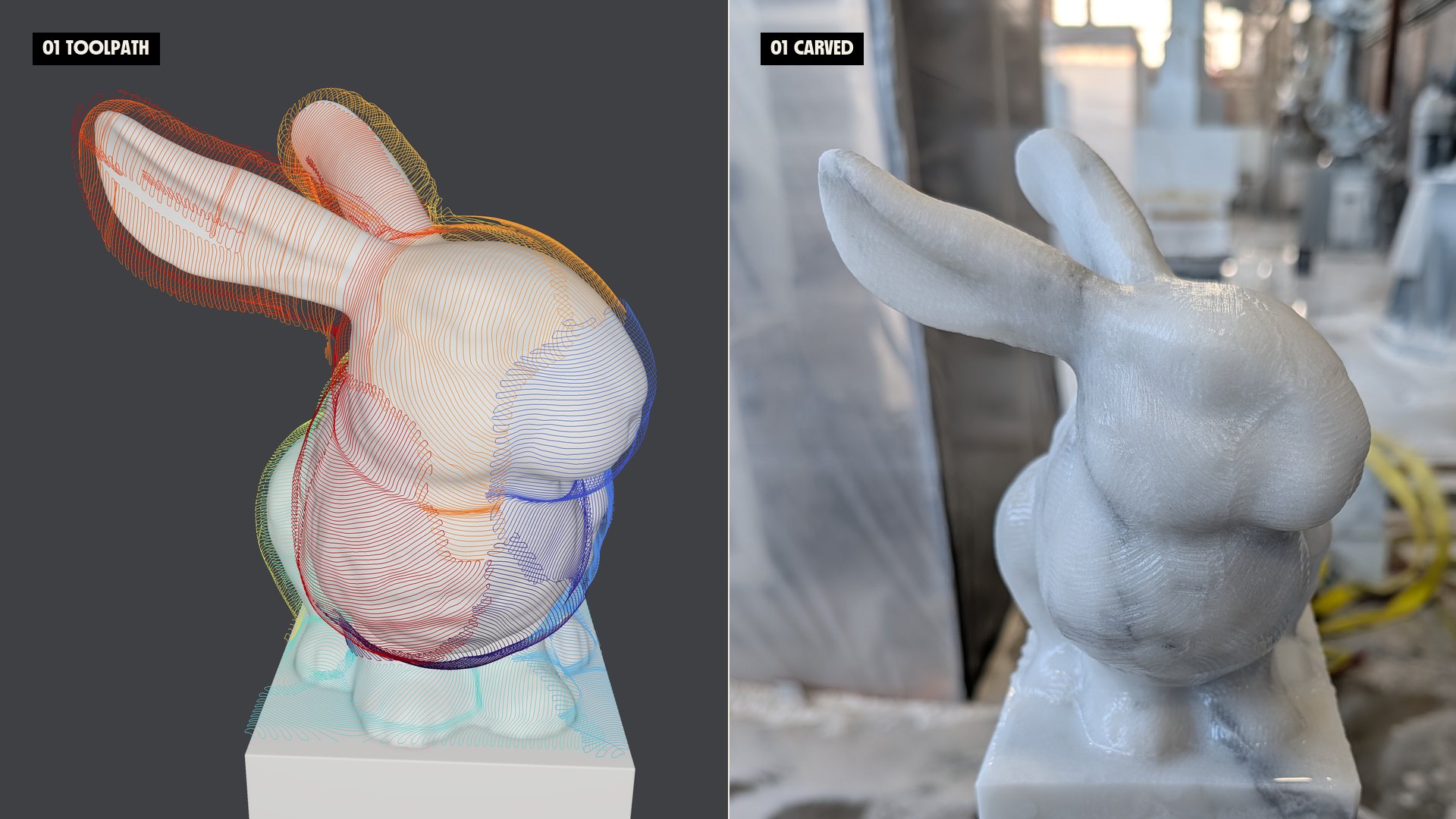
Wiesler, Sebastian Marino and James Darby presented the system at Embodied AI NYC. Their running example is the Stanford bunny, a scanned model widely used in computer-graphics research. The account places planned toolpaths beside photographs of the carved marble, making the connection between a digital surface and a physical cut unusually clear.
Original account and illustrated stages:
eleanorwiesler.com/blog/robotic-stone-carving/
Start with the stone that is still there
The system represents the block as a sparse grid of small volumes called voxels. That gives it a way to track which stone remains after a cut. A signed distance field describes how far points lie from a surface; the planner also uses surface directions to work out where cutting can happen.
Roughing removes the large volumes first. Smaller tools and finer passes approach the intended shape. Some areas cannot be reached from straight above, so the account shows tilted cutting planes clearing stone around overhangs. The rabbit’s ears and underside help explain why a simple stack of horizontal cuts is insufficient.
Follow a curved surface
Finishing starts from the simulated result of roughing and the target model. The planner creates successive layers, then divides each into regions that can be machined together.
Within a region, distance measured along the surface helps generate evenly spaced cutting curves. A straight line between two points could pass through the sculpture; a route following its surface stays with its shape. The system then connects the separate curves into continuous paths, reducing repeated lifting and repositioning of the tool.
Wiesler says machine learning helps adapt the paths to each sculpture and informs their connections. The system is proprietary, and the account does not disclose enough model or training detail to reproduce that contribution. The detailed geometric explanation should not be mistaken for an independent evaluation of the learning component.
The robot has to reach every cut
A route on the sculpture is only part of the job. The cutting tool needs a usable angle, and the robot’s joints need safe, smooth positions along the entire route. Monumental’s Hilbert application visualizes those limits and simulates the expected result before carving.
The stated automation target is the robotic manufacturing process. Human artists and designers still decide what to make; the company also says it intends to retain hand finishing for surface refinements. Its earlier architectural ornaments and figures illustrate conventional, manually programmed CNC work. They are not evidence that this new autonomous planner produced every piece in its portfolio.
What the demonstration establishes
The photographed bunny is a physical result, with visible machining marks, alongside its planned paths. The account explains how the team tackles bespoke toolpath preparation, which it says previously took weeks or months of manual CAM work per sculpture.
It does not provide a controlled comparison of programming time, cutting time, cost, surface error or failure rate. Those measurements would help a workshop decide when the automation earns its place. For now, this is an inspectable engineering case about planning cuts in a difficult material, with a clear distinction between simulated paths, carved stone and final human refinement.
Stanford’s original model repository:
graphics.stanford.edu/data/3Dscanrep/
Company’s project portfolio and hand-finishing context:
www.monumentallabs.co/work