TouchSynth: taking an AI-designed analog synth to the workbench
TL;DR: Tim, who publishes as cpldcpu, used Claude to design a small analog synthesizer and help test its first manufactured board. His November 14 making-of shows what connected the circuit simulations to real measurements—and where human guidance and unfinished tests still matter.
Hear the board recordings alongside the simulated versions:
cpldcpu.github.io/TouchSynth/
A circuit you can hear
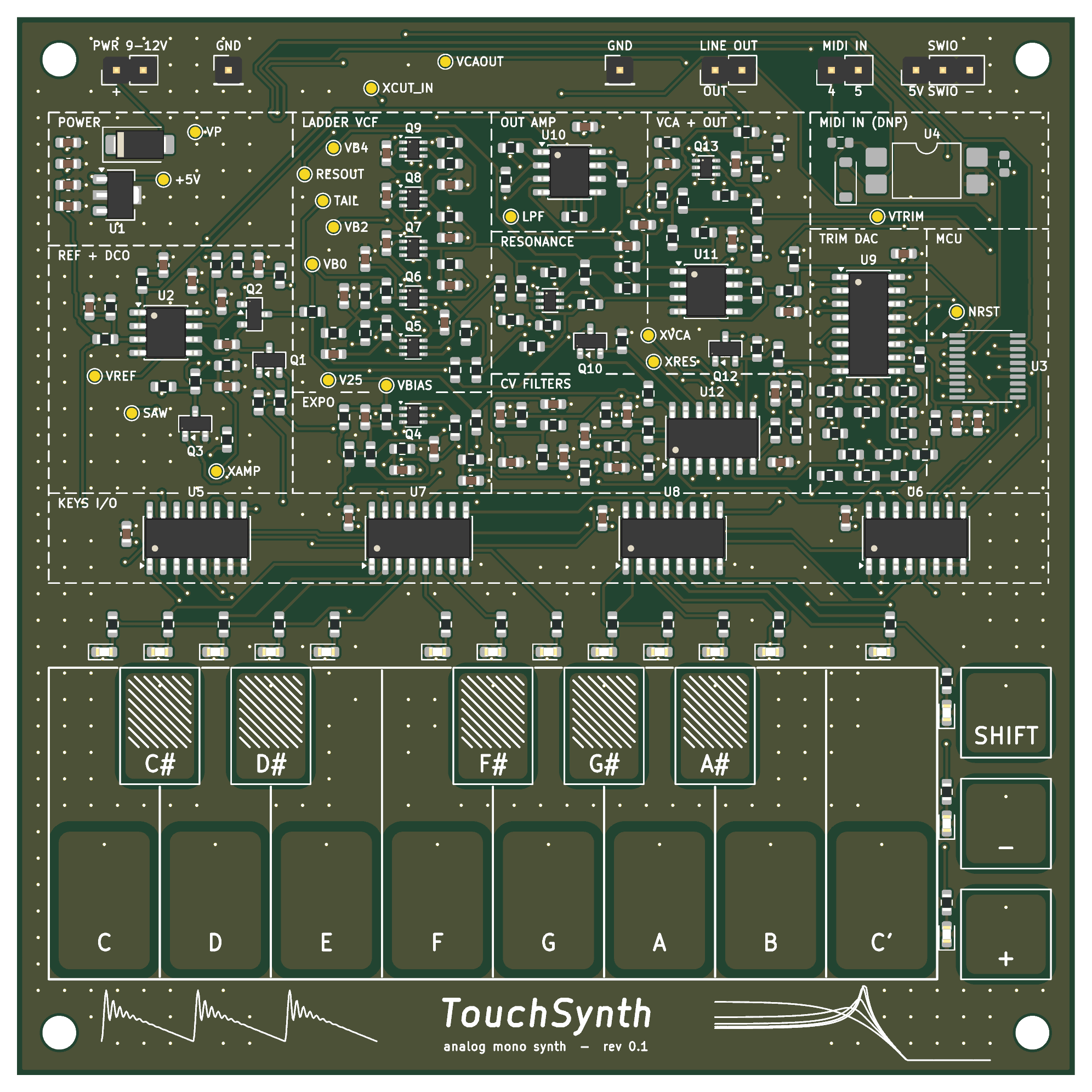
TouchSynth makes one note at a time. A microcontroller sets the pitch and control signals; an analog oscillator, transistor filter and amplifier shape the sound. The filter removes higher frequencies, with adjustable resonance that can make it sing on its own.
Tim began with Claude Opus 5.5, a small RISC-V microcontroller and a constrained catalogue of inexpensive parts. He proposed the touch-key synthesizer, reviewed the circuit and supplied access to KiCad, the ngspice circuit simulator and firmware tools. Claude generated the design and test programs.
The build’s roughly 19-hour design-to-order timeline includes long routing runs. Manufacturing and delivery took another two weeks.
Give the model something measurable
Before ordering, Claude simulated the circuit in ngspice. It also built a faster behavioural model and checked that model against the circuit simulation. Those are two software representations of the design; the website labels their audio separately from recordings of the assembled board.
The physical board includes a useful detail: a connection from its audio output back into the microcontroller’s measuring input. Alongside an oscilloscope, that gave the agent readings it could compare with the planned tests. Tim performed the first manual checks and fitted the microcontroller; Claude then controlled the lab computer remotely for further bring-up and calibration.
In the project’s test record, the amplifier produced a small voltage jump when a note started. Adjusting a trim value reduced that jump from about 33 millivolts to roughly zero, within a two-millivolt band. That is a specific measured adjustment on one board. The record also says the calibration still needed to be saved so it would survive a restart.
Where Tim had to intervene
Layout needed the most help. An initial cluster of analog components was difficult to route. Tim requested a floorplan organized by circuit function, moved from two copper layers to four, and suggested rearrangements to leave room for connections. He also removed a solder bridge from the microcontroller he had soldered by hand.
The touch keys needed recalibration and proved awkwardly small. Tim consequently controlled the synth with microcontroller programs. The impressive layered recordings are separate takes mixed together: the physical instrument still plays one note at a time.
Forum administrator Andreas S. specifically welcomed the AI-led bring-up and calibration as a way to reduce manual work. That is informed appreciation of the workflow, rather than an independent reproduction of the board’s measurements.
www.mikrocontroller.net/topic/588187
A useful comparison, with different boundaries
Anthropic’s November 9 electronics report describes three Fable 5.2 prototypes built with Diode engineers: a speakerphone, voice-assistant hub and handheld pet. The company reports working devices, while explicitly leaving electrical validation, antenna tuning, thermal testing and certification unfinished. It also discloses a commercial relationship with Diode.
TouchSynth adds an inspectable account of instrument-connected testing with an earlier model. These are different devices, people and conditions; their results cannot rank the models against each other.
www.anthropic.com/research/claude-electronics-design
What remains open
TouchSynth’s verification plan separates circuit checks from validation as a playable instrument. It leaves touch-scan rate, MIDI and user-playing tests open, records a clock-related tuning offset and flags broadband noise above its target. The measuring input itself limits how well that noise target can be checked; the plan calls for an audio-interface measurement.
The original build account and dated test record let you follow those remaining jobs:
cpldcpu.github.io/2026/11/14/touchsynth/
github.com/cpldcpu/TouchSynth/blob/master/docs/verification_plan.md