Energy-Based Reasoners learn a score that guides the next puzzle-solving step

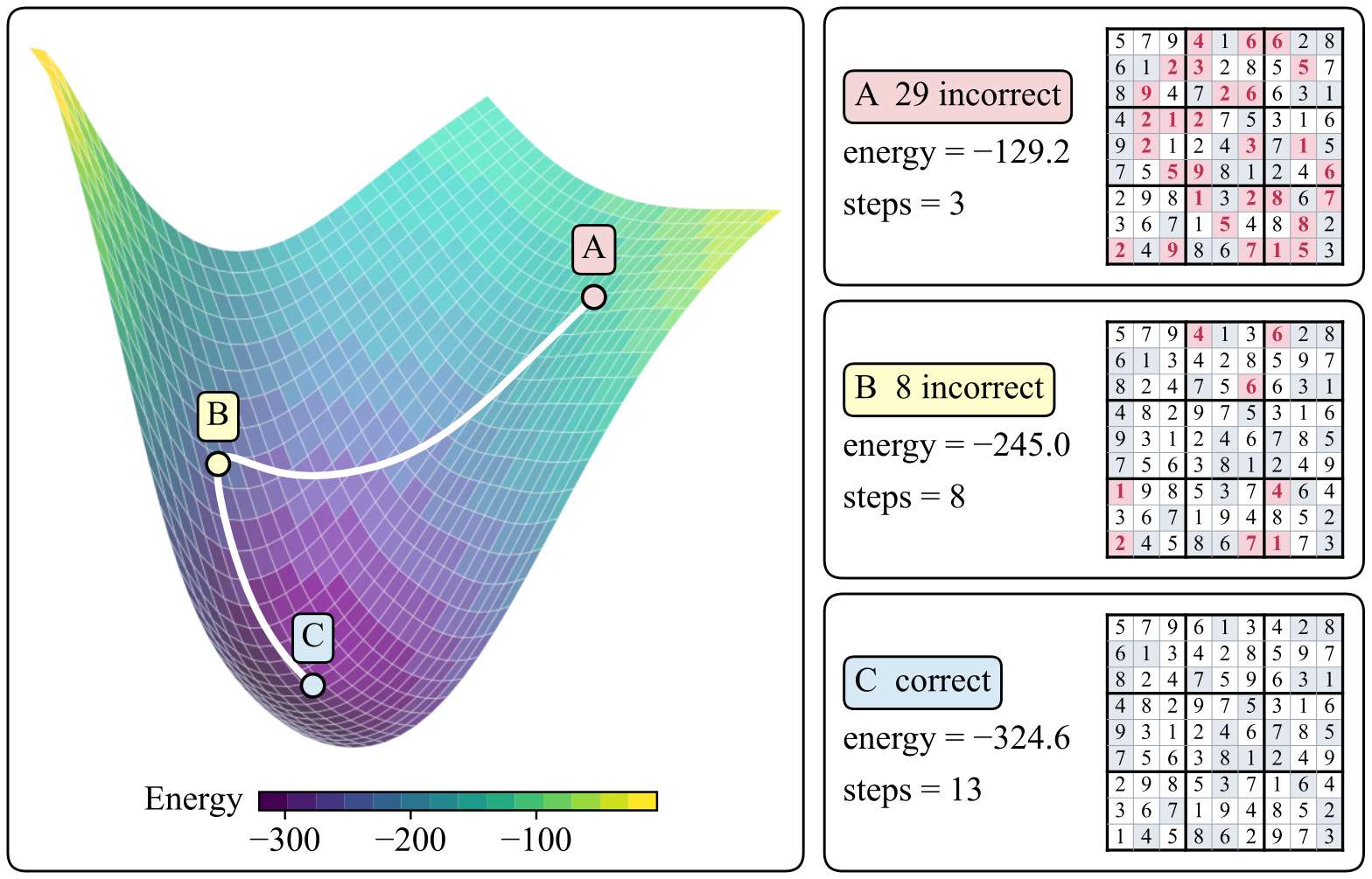
Instead of repeating a neural block for a fixed number of steps, Energy-Based Reasoners learn a score over a puzzle’s internal state. Its gradient guides revisions; a small gradient signals when to stop, and the score helps choose among candidate answers.
Chen and colleagues’ November 6 preprint reports 99.4% exact accuracy with one sample on Sudoku-Extreme, rising to 99.9% with five. The test contains 422,786 puzzles; training starts from 1,000 puzzles expanded through valid transformations. Results average three training seeds.
The comparisons concern learned puzzle solvers; they establish no speed advantage over ordinary Sudoku algorithms or broader chatbot ability. Maze gains are smaller, and training through gradients adds overhead. Code is available; ARC training configurations and checkpoints are still forthcoming. This is an author-reported research result, without an independent replication here.